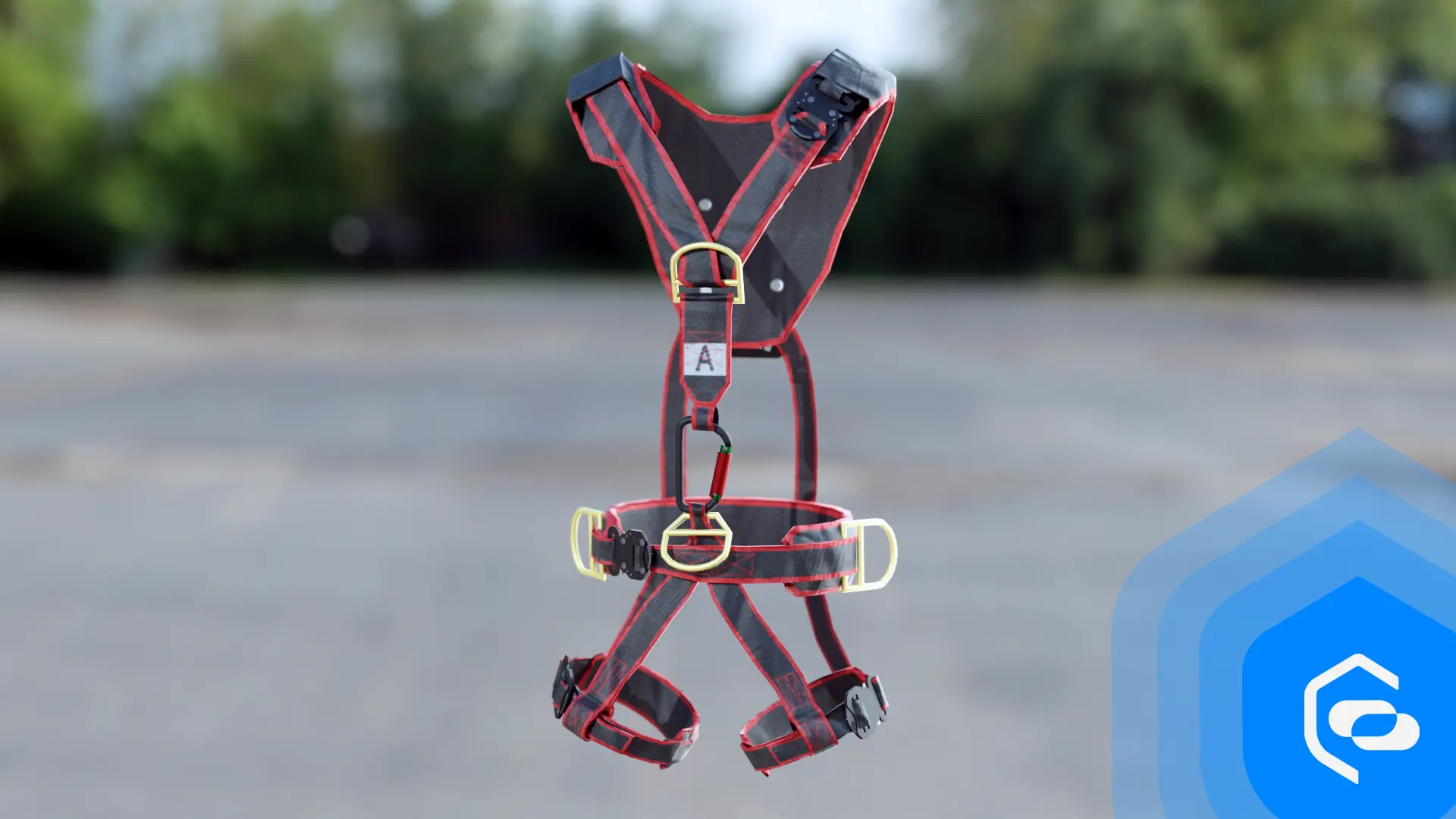
Safety Harness - Ready-to-Use OHS Presentation for Training Sessions
Łukasz Kamiński6 min read
As an employer or OHS specialist, ask yourself
Are your employees properly prepared to inspect their personal protective equipment (PPE) before and after use, in line with the manufacturer’s instructions?
PPE must be inspected regularly and thoroughly by a competent person, following the user manual provided by the manufacturer. A competent person is someone who:
fully understands the hazards associated with the work and the equipment,
has both practical and theoretical knowledge, gained through training by the manufacturer or its authorized representative for the specific PPE,
can identify significant damage, assess the risk and take the necessary corrective action.
Fall protection PPE: inspection and use
Personal protective equipment against falls from height (as defined in Regulation (EU) 2016/425 of the European Parliament and of the Council of 9 March 2016 on personal protective equipment) is designed to be worn or held by a person to protect them against one or more health and safety hazards. To keep users safe, it must be inspected before and after each use, and periodically.
Equipment for work at height should only be used by people trained to use it safely. How often it is inspected depends on the conditions of use, but periodic inspections must take place at least once every 12 months. They must be carried out by a competent person, strictly following the manufacturer’s recommendations.
In this article, we look at the key aspects of safety harnesses: their construction, functions, service life, common defects and inspections. Above all, we discuss how to train employees so that they have the knowledge they need to inspect their equipment.
We have prepared ready-to-use training materials, a presentation and a poster, both covering the essential information on safety harnesses.
Recommended safety harnesses
Safety harnesses that meet the EN 361, EN 358 and EN 813 standards are available from Suski:
Manufacturers must ensure that every PPE product placed on the market is marked with its type, batch or serial number, or other information that allows it to be identified. If the size or nature of the PPE does not allow direct marking, this information must be given on the packaging or in the accompanying documents.
PPE must be designed and manufactured so that it:
fits properly and stays securely in place for the whole intended period of use, taking into account the environment, the user’s movements and changes of posture,
can be adapted to the user’s body with suitable adjustment and fastening systems or a sufficient range of sizes.
PPE designed to prevent falls from height must include a harness and a connecting system that attaches to a reliable anchor point. It must be designed to minimize the fall distance, prevent collisions with obstacles and keep the braking force below the level that causes injury. After arresting a fall, the PPE must hold the user in a safe position while they wait for rescue.
The manufacturer’s instructions should include
the requirements for a reliable anchor point and the minimum clearance needed below the user,
how to put on the harness correctly and connect the system to the anchor point,
a product datasheet with technical specifications,
installation parameters and working conditions,
guidelines for storage, use and maintenance,
information on the service life of the product,
the validity of certification markings.
PPE inspections
Regular inspections are crucial to keep safety harnesses reliable and safe. There are three types of PPE inspection.
1. Pre-use and post-use inspections
Carried out before and after each use to check that the equipment is in proper working condition.
2. Periodic inspections
Must be carried out at least once a year (every 12 months).
Carried out by a competent person with specialist knowledge and training.
More frequent inspections may be needed, depending on the working conditions.
3. Special inspections
Required after each use of specialist equipment, such as rescue kits.
Pay particular attention to textile components, which are more prone to wear and damage.
Service life and withdrawal from use
Safety harnesses may only be used within the service life specified by the manufacturer. They must be withdrawn from use immediately and disposed of if:
they have arrested a fall,
their reliability is in doubt because of visible damage or wear.
Harsh working conditions, such as water, sharp edges, corrosive substances or extreme temperatures, can shorten their service life significantly, even to a single use.
Any PPE that shows signs of damage must be taken out of use and thoroughly inspected. Users must report unusual events, such as falls, impacts, exposure to extreme temperatures or unauthorized modifications.
Maintenance and storage
To keep them in good condition, safety harnesses must be cleaned and maintained regularly according to the manufacturer’s guidelines.
Store them where they are protected from:
moisture and humidity (in a well-ventilated, dry place),
direct sunlight and UV radiation,
dust, sharp objects and contaminants,
extreme temperatures and corrosive substances.
Safety harness inspection guide
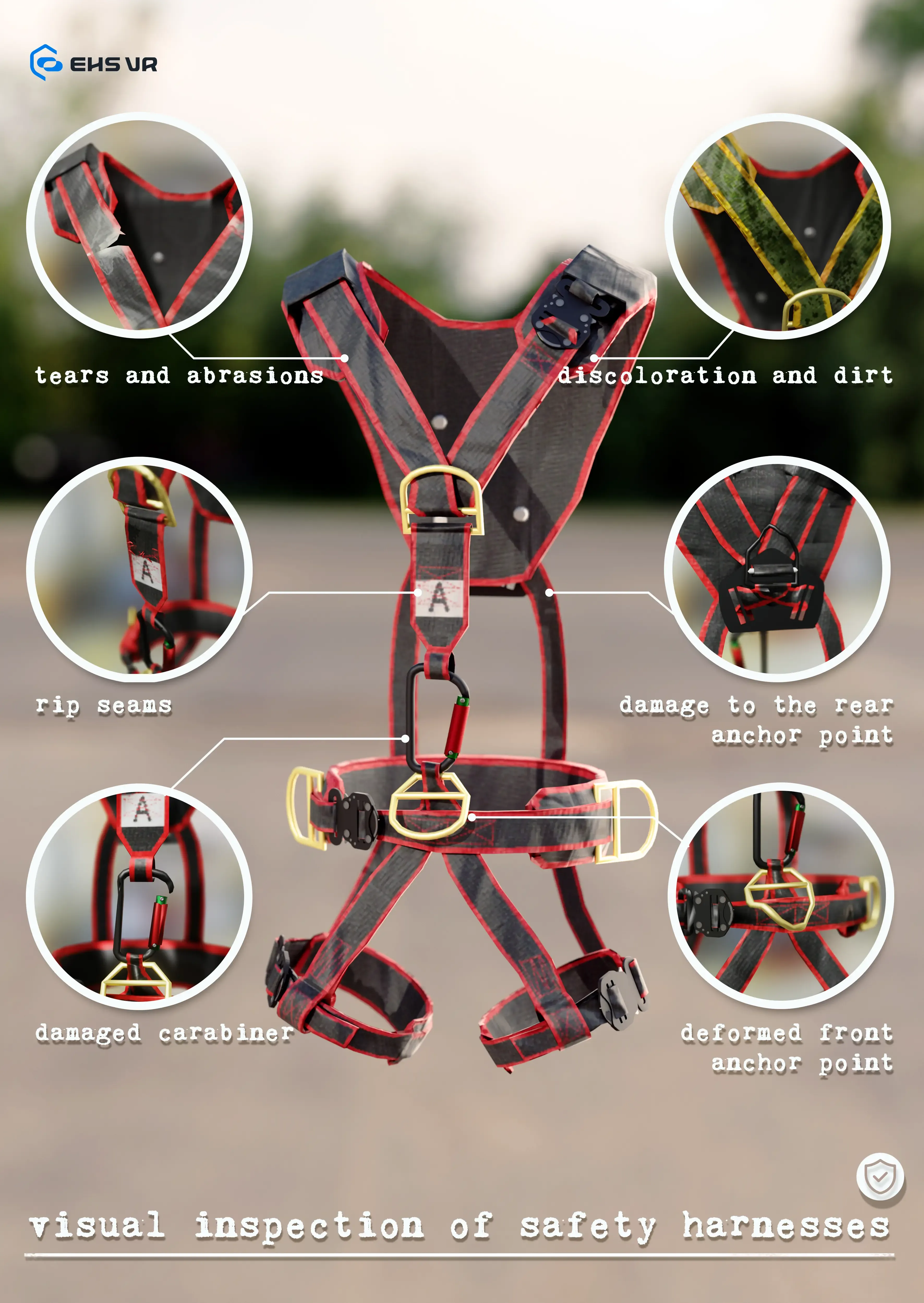
To make routine inspections easier, we created a visual guide that shows the key points to check. You can use it as a quick-reference checklist for daily inspections.
We have also prepared a presentation for training sessions. The presentation and the poster are visual aids for pre-use checks; they do not replace periodic inspections.
The presentation is currently available in Polish: open the PowerPoint version to use the presenter notes and animations.
How to train?
An essential tool for OHS training
People learn through experience, so employees should have the chance to inspect safety harnesses in the training room. The presentation can serve as a reminder, printed and displayed in the room where PPE is stored. But is it enough as a training tool? In response to the needs of OHS specialists, we created training in virtual reality. The knowledge usually taught in training rooms has been built into an application that has become an essential tool for specialists.
There is no need to bring damaged or dirty harnesses into the training room: simply give your workers the VR application, which can be used for:
on-the-job instruction,
periodic OHS training,
thematic OHS briefings,
initial OHS training.
With VR headsets and the training scenarios, training is easier than ever: at any time, anywhere, ideally before every task at height. Testing the VR applications is free. Sign up for a free trial and see how virtual reality can improve safety training in your workplace.
With your consent we use cookies and similar tools from Google and Meta to measure traffic and improve our ads, and we load the Pipedrive chat. You decide: the site works fully without them. Privacy policy
 Łukasz Kamiński